

Surf camp or a traditional surf school: which option should you choose to improve your skills?
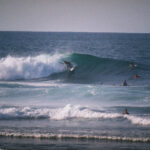
Where to learn to surf in Fuerteventura, Canary Islands?
You might think that surfing is a purely instinctive sport: all you need to do is grab your board, paddle vigorously, and then stand up as soon as the wave comes. However, the most experienced surfers will tell you that the real ride begins long before your feet touch the water. It starts with carefully observing and understanding the ocean. This is what is known as reading the waves.
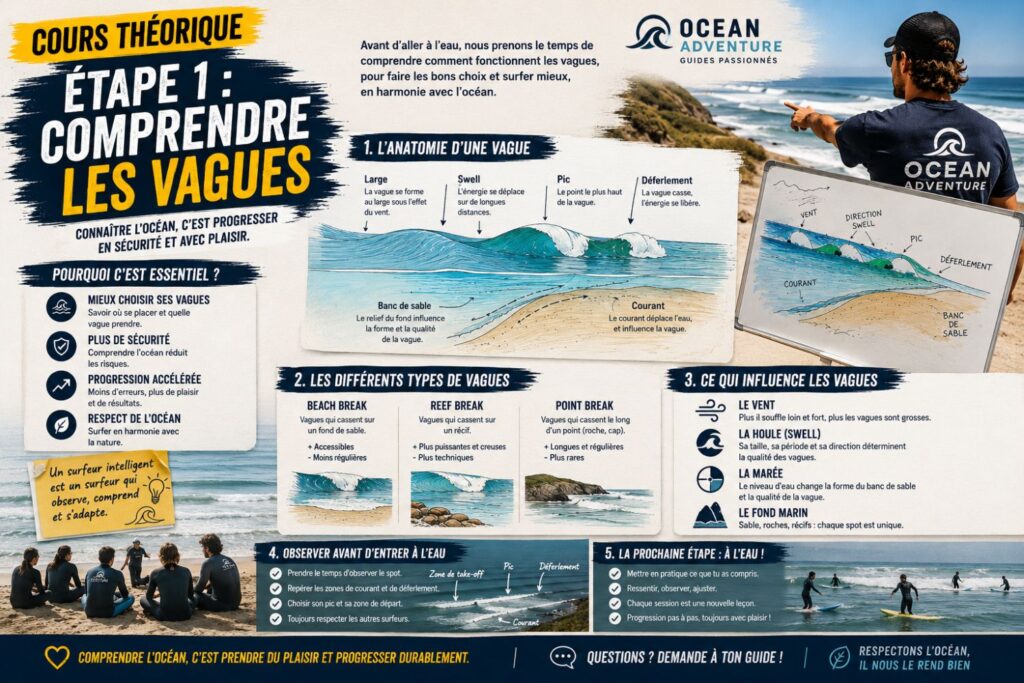
At Surf & Yoga Camp Hossegor, we firmly believe that a surfer who does not understand their environment is a surfer on borrowed time, destined to tire quickly or find themselves in dangerous situations. That is why our courses include in-depth theory lessons. In this first stage, you’ll discover how the weather, swell, tides and sandbanks combine to create the perfect wave.
Contenus de la page
The birth of a wave: understanding swells
The wave you’re surfing in Seignosse or Hossegor doesn’t form near the shore. It’s the result of a long journey across the Atlantic Ocean. It all begins with a low-pressure system, often situated far out at sea, near Greenland or Iceland. The strong winds generated by this storm blow across the sea’s surface, creating chaotic ripples known as the ‘wind-driven sea’[1].
As they move away from this stormy area, these undulations become more organised, spread out and grow more regular: this is what is known as the swell (or swell in English). The further the swell travels, the cleaner and more powerful it becomes. It is precisely this phenomenon that has earned the Landes coast its worldwide reputation, as it is exposed to swells from the North Atlantic with nothing to slow them down.
“The swell is the ocean’s raw energy. Surfing is the art of harnessing that energy with elegance.”
To interpret weather forecasts correctly, you need to pay attention to three key parameters of the swell: size, period and direction. Size, expressed in metres, corresponds to the height of the swell out at sea, which will determine the height of the waves you’ll encounter on the beach. The period, measured in seconds, represents the time between two successive swell crests. A long period, generally over 10 seconds, indicates a powerful swell capable of hollowing out the wave as it hits the sandbanks[2]. Finally, the direction of the swell has a significant influence on the quality of the waves: a swell coming from the west-north-west will strike the Landes coast directly, whilst a swell from the south will be partially blocked by the Spanish coast.
The local wind: the architect of the wave
Whilst the swell provides the energy, the local wind plays a decisive role in shaping the wave’s final form. As the wave approaches the shore, it becomes highly sensitive to the prevailing weather conditions, and you can easily observe the effects of different types of wind.
The onshore wind (blowing from the sea towards the land) is often regarded as a surfer’s nemesis, as it flattens the wave, making it choppy, churning and difficult to anticipate. This phenomenon is common on summer afternoons due to thermal breezes. Conversely, an offshore wind (blowing from the land out to sea) is ideal: it hollows out the wave face, smooths it and delays its break, resulting in steeper waves and, for experienced surfers, the chance to catch perfect tubes. Finally, the complete absence of wind, known as glassy conditions, creates a water surface as smooth as a mirror, often visible at sunrise or sunset.
At our Surf Villa, you’ll learn how to read wind charts to identify the best times to surf. It’s to make the most of these glassy or offshore conditions that our sessions are often scheduled early in the morning or late in the day.
The tide: the silent conductor
The Atlantic Ocean is subject to a large tidal range, meaning there is a significant variation in water level between high tide and low tide. This cycle, which lasts around six hours, radically alters the character of a surf spot.
A wave breaks when the water depth falls below approximately 1.3 times the height of the wave. Thus, depending on the state of the tide, the swell will interact differently with the sandbanks:
| Tide information | Impact on waves (in general) |
|---|---|
| Low tide | The waves break far from the shore; they are often deeper and faster. However, you must remain vigilant due to the shallow water. |
| Mid-tide (rising or falling) | It’s often the perfect time: the waves are in good shape and break nicely. |
| High tide | The water is deeper, which can result in gentle waves or cause violent breakers near the shore, such as shorebreak. |
For this reason, at Surf & Yoga Hossegor, we do not impose fixed timetables for our lessons. Our instructors adjust the schedule daily to suit the tide times, to ensure you enjoy the best possible learning conditions – ones that are both safe and enjoyable.
Sandbanks: the hallmark of the Landes coastline
Unlike coral or rocky reefs, which are fixed, the Landes coastline is a vast beach break, that is to say, a shifting sandy seabed. The sandbanks are constantly reshaped by winter storms, currents and tides. This dynamic makes the spots at Seignosse and Hossegor very lively, but also complex to get to grips with[3].
A good sandbank, often called a ‘baïne’, forces the wave to break gradually from left to right or from right to left, creating a shoulder that you can ride comfortably. On the other hand, a sandbank that is too straight causes the wave to break simultaneously along its entire length – a phenomenon known as close-out – rendering the wave unrideable.
“Learning to spot a good sandbank from the dune will save you hours of pointless rowing.”
Casernes Beach, our favourite spot, is renowned for the quality and gentleness of its sandbanks. They offer longer, less powerful waves than those in the centre of Hossegor, making it the ideal place to improve your skills with confidence.
Becoming an independent surfer
Understanding these four elements — the swell, the wind, the tide and the sandbanks — is the first step towards becoming a truly independent surfer. That is the difference between being at the mercy of the ocean and playing with it.
At our camp, we take the time to pass on this valuable knowledge to you. You’re not here to blindly follow an instructor, but to learn how to observe, analyse and make your own decisions. Join us as we unravel the secrets of the ocean together and turn every session into a real lesson in nature!