



Just ten years ago, you would probably have thought that a surfer’s training boiled down to one thing: spending as much time as possible in the water. Physical training out of the water was often seen as pointless, or even at odds with the free-spirited nature of surfing. Today, you can see a radical shift in this approach.
You only have to look at the warm-up routines of professional surfers on beaches around the world: without exception, they all do mobility, stretching and breathing exercises before clipping on their leashes.
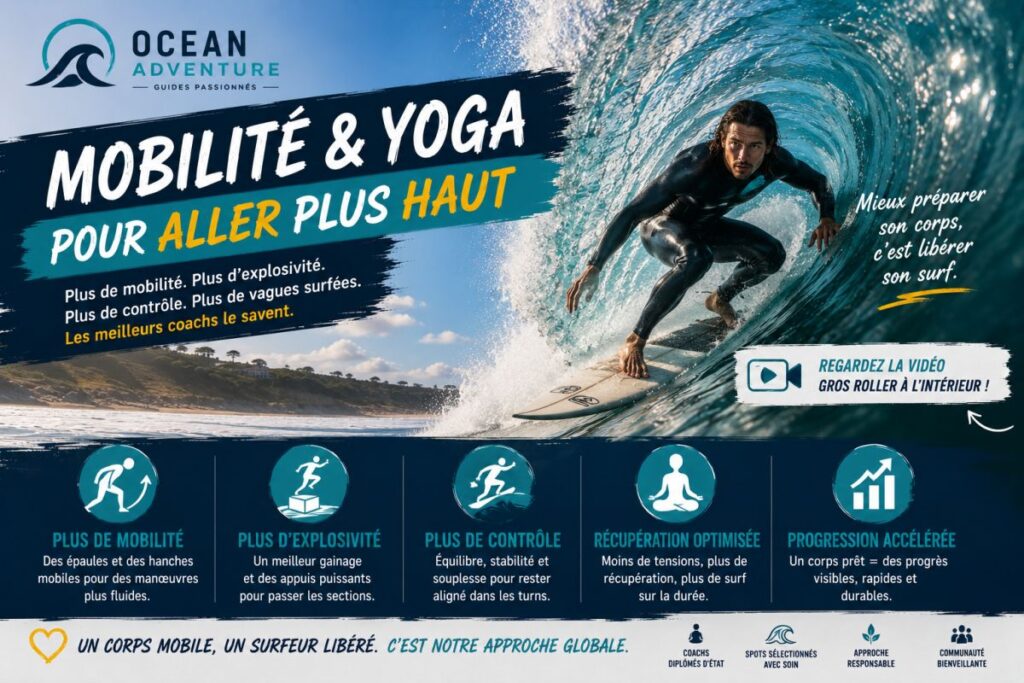
This transformation isn’t just for the global elite. At Surf & Yoga Camp in Hossegor, you’ll discover that we’ve placed functional yoga at the heart of our teaching approach. Why do our coaches place such emphasis on this aspect? Because they know that a stiff body on the sand will never move fluidly on a wave.
Contenus de la page
Surfing: a sport with specific biomechanical demands
To understand why mobility is so important, it is essential that you grasp what surfing demands of your body. Unlike sports such as running or cycling, surfing is an asymmetrical and intermittent activity. You alternate between intense paddling phases, periods of waiting, and extremely brief bursts of power during the famous take-off.
Rowing, for example, involves prolonged hyperextension of the spine and places significant strain on the rotator cuff – that is, your shoulders. The take-off, on the other hand, requires rapid and precise movement of the hips and ankles so that you can move from a lying position to a standing position in a fraction of a second. Finally, gliding requires deep core strength so that you can maintain your stability on a moving surface.
“Your technical errors in the water are very often a direct result of a lack of mobility on land.”
If you experience stiffness in your hips after long days spent sitting down, your take-off will inevitably be slow and your knees may hit the board. If your shoulders are stiff, your paddling will be less effective and may even become painful. No matter how often your coach repeats the correct technique to you, your body won’t be able to execute it if you lack the necessary mobility.
Functional yoga: unlock your full potential as a surfer
This is precisely where yoga comes into its own. And bear in mind, this isn’t about static meditation, but functional and dynamic yoga, designed specifically to address the specific biomechanical demands of surfing.
At our Surf Villa, your day begins with a morning session led by professionals who have a thorough understanding of the physical demands of surfing. You’ll work on key areas of the body, with direct and visible benefits for your surfing:
| Areas targeted by yoga | Instant results on your surfboard |
|---|---|
| Opening up the pelvis and hips | A smoother take-off, without the risk of catching your toes on the board. |
| Chest and shoulder mobility | A wider and faster stroke, whilst reducing the risk of tendonitis. |
| Stretching the posterior chain | A lower, more stable stance when standing on the wave. |
| Strengthening the abdominal muscles | Better balance and optimum power delivery when cornering. |
By releasing these key areas, you give your body the freedom of movement it needs to finally put your coach’s technical advice into practice. This approach is, in fact, supported by sports physiology, which emphasises the importance of joint mobility in improving performance and reducing the risk of injury[1].
Breathing: a key tool for managing stress and exertion
Another fundamental pillar of yoga, which is often underestimated, is breath control, known as Pranayama. You are moving in a powerful ocean environment, which can cause significant stress, particularly when passing the bar or after a prolonged fall underwater.
Breathing techniques help you to slow your heart rate, oxygenate your muscles more effectively and, above all, resist the urge to panic. A surfer who has mastered their breathing is a clear-headed surfer, capable of reading the ocean and making the right decisions, even in challenging conditions. This mastery of breathing is supported by neuroscience research on wellbeing, which shows that controlled breathing reduces stress and improves concentration[2].
“Flexibility helps you get up on the board. Breathing helps you stay calm when the wave washes over you.”
Recovery: the secret to lasting stamina
Finally, the most experienced coaches know that a week-long course is a real marathon, not a sprint. Five consecutive days of surfing puts your muscles under intense strain. Without an active recovery routine, muscle soreness builds up and fatigue can spoil the end of your holiday.
Post-session yoga helps you stretch tight muscles, flush out built-up lactic acid and relieve lower back tension. Combined with our healthy half-board programme, designed by a nutritionist, this routine ensures you recover fully so that you wake up feeling great every morning.
Incorporating yoga into your surfing training is therefore not just a passing fad, but the smartest and most body-friendly way to make lasting progress. We invite you to come and experience this unique synergy at Surf & Yoga Hossegor, and finally unleash your true surfing potential!