


If you’ve ever taken surfing lessons, you’ve no doubt experienced this frustration: the instructor gives you a tip from the beach or from their board, you’re convinced you’ll put it into practice on the next wave, and yet you often end up with your head in the whitewash. How can we explain this discrepancy between what you think you’re doing and what you’re actually doing?
The answer lies in a well-documented phenomenon in neuroscience: under the strain of the cognitive load imposed by the action (reading the wave, maintaining balance, anticipating take-off), the brain simply no longer has the capacity to observe itself.
You don’t notice your mistakes because your attention is completely focused elsewhere.
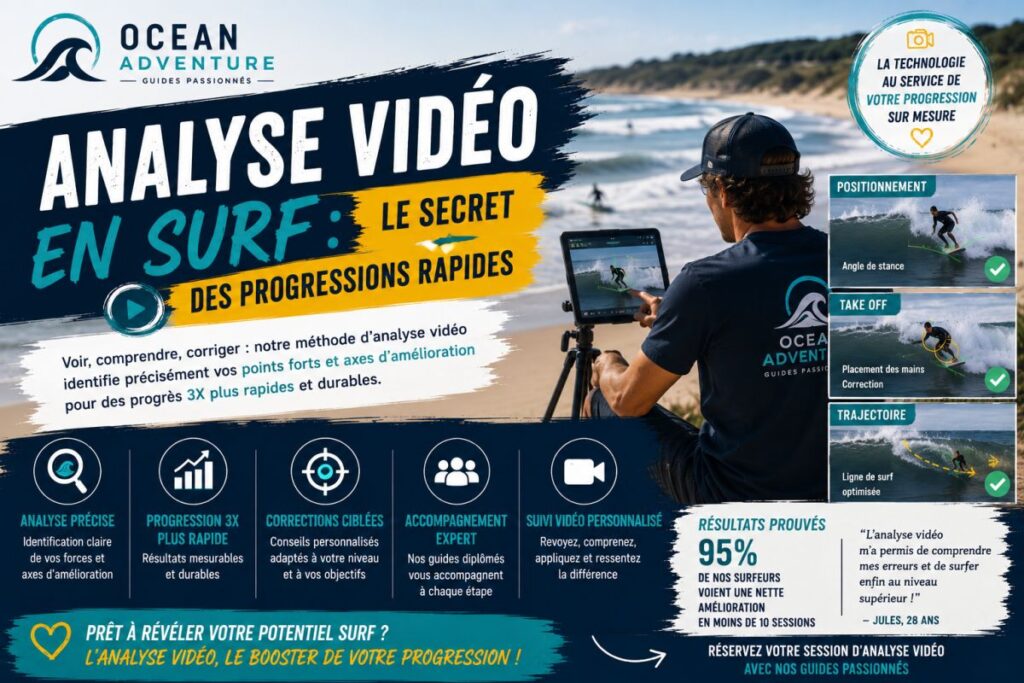
At the Hossegor Yoga & Nature Surf Camp, we have incorporated a powerful tool to dispel this illusion and speed up your learning: video analysis. Once the preserve of top-level athletes, this method is now the cornerstone of our approach to helping you take your technique to the next level in record time.
Contenus de la page
Why verbal advice isn’t always enough
Surfing is an instinctive sport where every tiny adjustment counts. A slightly misdirected glance, a foot moved by a few centimetres, or excessive stiffness in the hips can jeopardise a take-off or prevent a smooth turn. When your instructor tells you to ‘bend your legs more’, you might feel as though you’re already crouching, even though your posture remains almost upright. This isn’t down to a lack of attention on your part, but simply because your brain hasn’t yet internalised the correct posture to adopt.
Verbal corrections have their limitations when dealing with complex biomechanical flaws that occur in a fraction of a second. Indeed, according to neuroscience research on body awareness, proprioception requires visual feedback for the effective recalibration of your posture and movements[1].
“Until you’ve seen your mistake with your own eyes, it’s extremely difficult to correct it. A picture never lies.”
How does video analysis work at our surf camp?
To overcome this challenge, we have made video analysis an essential part of your week-long training course. This tool is integrated in a smooth and supportive way, without any pressure to perform, so that you can make progress at your own pace.
During your sessions at Les Casernes beach, you’ll be filmed in action. Our instructors carefully select the camera angles to analyse your paddling, take-off and riding posture. In the evening, we’ll gather in the comfort of the Surf Villa for a group viewing session.
The coach then pauses the video, uses slow motion and analyses your movements in detail. This allows you to see the exact moment when your gaze dropped downwards, causing you to fall, or the incorrect position of your hand on the board’s rail. This method is based on principles of sports physiology which show that immediate visual feedback optimises motor memory and accelerates learning[2].
The three key insights provided by video analysis
The effectiveness of this method is impressive. From the very next session following the video debrief, you can see rapid and significant progress. This tool acts as a real learning accelerator by triggering three key realisations:
| The moment it all clicked | The impact on your progress |
|---|---|
| Objective awareness | You can clearly see the discrepancy between how you feel (‘I’m bent’) and reality (‘I’m stiff’). Your brain can then immediately recalibrate your instructions. |
| Understanding timing | Slow-motion footage allows you to pinpoint exactly when to row harder and when to initiate the take-off, which is crucial to the success of your manoeuvres. |
| Highlighting successes | Video isn’t just for pointing out your mistakes. Seeing your best waves on screen significantly boosts your confidence, which, according to INSEP[3], is a key factor in performance. |
“Video analysis replaces hours of trial and error in the water with immediate, targeted correction.”
A caring and relaxed approach
It’s normal to feel a bit nervous about seeing yourself on camera, especially when you’re just starting out and you’re having a few wobbles. Rest assured: our debriefing sessions always take place in a supportive and often very friendly atmosphere.
In our small groups (a maximum of 20 people at the Villa, 5 to 8 per class), the video becomes a chance to share experiences. You laugh at your own ‘slips and falls’, you cheer on others’ progress, and you take the pressure off the learning process.
If you’re fed up with hitting a plateau and not understanding why you’re struggling, it’s time to step it up a gear. Join Surf & Yoga Hossegor, smile for the camera, and get ready to see your surfing improve right before your eyes!