


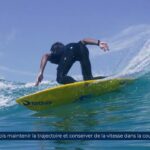
25. How to successfully perform a back cutback?

Biarritz: The 10 Best Hotels Facing the Sea

The front cutback is one of the most elegant manoeuvres in surfing: a controlled turn that allows you to return to the power of the wave as you move away from its breaking point. This movement, both fluid and precise, combines commitment, technique and anticipation. Inspired by the logic of the back bottom turn, it requires you to play intelligently with the rails to trace a controlled arc… then return with speed down the slope. In this article, we will explore this key move step by step to help you better understand the mechanics of the cutback and execute it with intention.
Contenus de la page
Beginners’ special: understanding (and avoiding) the pitfalls of cutbacks
The cutback is a magnificent manoeuvre… but also one of the most misunderstood when you’re just starting out. Before you get started, here are a few essential points to avoid common mistakes:
1. Do not force rotation with your arms.
Many beginners pull too hard with their arms to initiate the cutback, which immediately throws the board off balance.
👉 It is your gaze that initiates the turn, your shoulders that guide it, and your support that refines it — your arms merely accompany the movement, never the other way around.
2. Do not turn too early
If you start the cutback before you have enough speed, the board will stall or stop. Let the wave carry you first, move slightly away from the power zone… then come back into it with intention.
3. Keep your knees flexible
A “stiff” cutback prevents the board from working properly on the rails.
👉 Stay semi-bent, mobile, ready to absorb the thrust and adjust your weight according to the phase of the turn.
4. Control your rails, not just your back foot
The beginner’s reflex: putting all your weight on your back foot.
👉 A good cutback, even a simple one, involves feeling the transition from outer rail → inner rail, not just pushing hard. Look for the feel, not brute force.
5. Look where you want to go — never at your feet.
Your gaze traces everything:
-
-
first towards the centre of the wave (the point you are aiming for),
-
then towards the place where you want to descend. Looking at your feet automatically stops the rotation and breaks the whole movement.
-
6. Accept that you will fail… it’s normal
Cutbacks require speed, timing, balance and wave reading skills. Falls, loss of balance and missed trajectories are all part of the process. The key is to remain fluid, observe the wave and understand what went wrong (speed? support? focus? anticipation?).
The Cutback: returning to the energy of the wave
As you move away from the breaking point, your board gradually loses power. The purpose of the cutback is to bring you back to exactly where the wave creates its energy: the area where it breaks. It is an essential manoeuvre for maintaining your speed and restarting your trajectory.
First step: engage the outer rail
As with a backside bottom turn, it all starts with a committed turn on the outside rail.
- You start your turn by pushing the outer rail firmly into the water.
- Your gaze locks onto the heart of the wave, where you want to return.
- Your front arm becomes your pivot point, almost like a compass guiding your movement.
- Your back arm accompanies the rotation, toned, open, guiding your shoulders.
In this first phase, the upper body provides the momentum, and the board naturally follows the movement.
Second step: aim for the breaking zone
As you move up towards the section that breaks, your gaze shifts to a new target:
- You focus your gaze on the breaking zone.
- Your front arm, still leading, initiates the rotation of your upper body.
- Your shoulders open up and your back arm continues to accompany the movement.
It is this anticipation of the body that allows you to enter the turbulence with control and precision, without being overwhelmed by the wave.
Third stage: initiating the second turn
Just before reaching the turbulence:
- You must anticipate the return before you even touch the foam.
- Your gaze plunges towards the bottom of the wave, where you want to start again.
- The board then moves from the outer rail to the inner rail, initiating the return turn.
This rail change is the key to a successful cutback: smooth, clean, without losing speed.
Last step: maintain your speed, always
A cutback is not only measured by its shape, but also by the speed you maintain on the way out.
To successfully perform the sequence:
- Keep the movement continuous and smooth.
- Allow the inner rail to resume the downward line.
- Remain semi-bent, stable and ready to restart.
The key: never break momentum, even when going through turbulence. A good cutback is a smooth circle, not a stop.



Improve your surfing by incorporating mobility exercises and yoga
Lire la suite