


The Best Wetsuits for Winter 2025 – 2026
Hendaye: The 10 Best Hotels Facing the Ocean
Contenus de la page
Identify and correct the mistakes that are sabotaging your progress
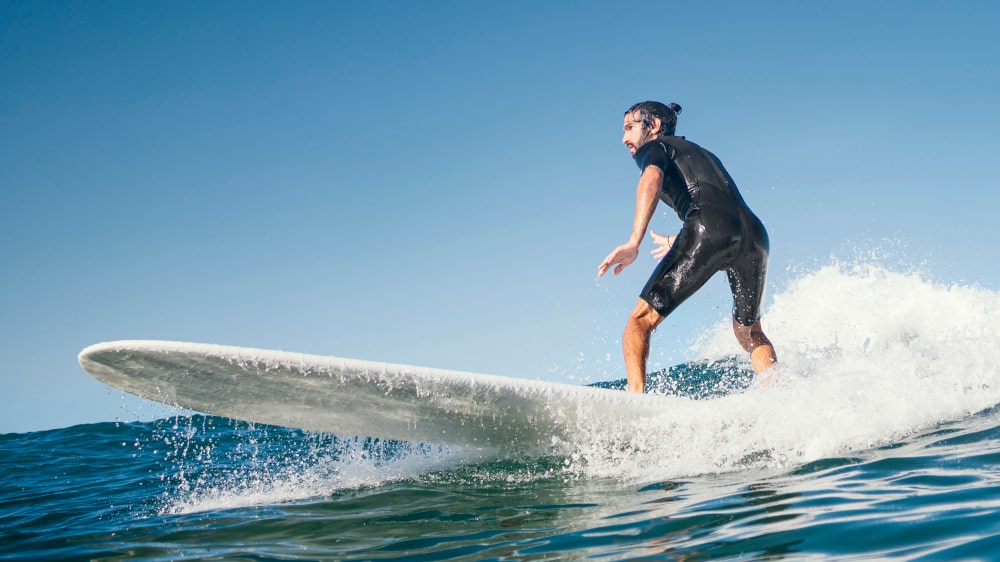
The take-off is the most critical moment in surfing, that magical transition between paddling and gliding that determines the success or failure of your wave. However, 90% of beginner and intermediate surfers make the same recurring mistakes that sabotage their attempts and limit their progress. These mistakes, often subtle but with dramatic consequences, turn perfectly catchable waves into missed opportunities and lead to frustration and technical stagnation.
Understanding and correcting these classic mistakes is the key to unlocking your potential and achieving fluid, consistent surfing. Each mistake analysed in this guide reveals not only the problem but also its concrete solution, allowing you to turn your weaknesses into strengths. These corrections, applied methodically, will revolutionise your take-off and pave the way for accelerated progress towards surfing excellence.
Mistake #1: Late Position Relative to the Wave
The Problem: Always Late to the Game
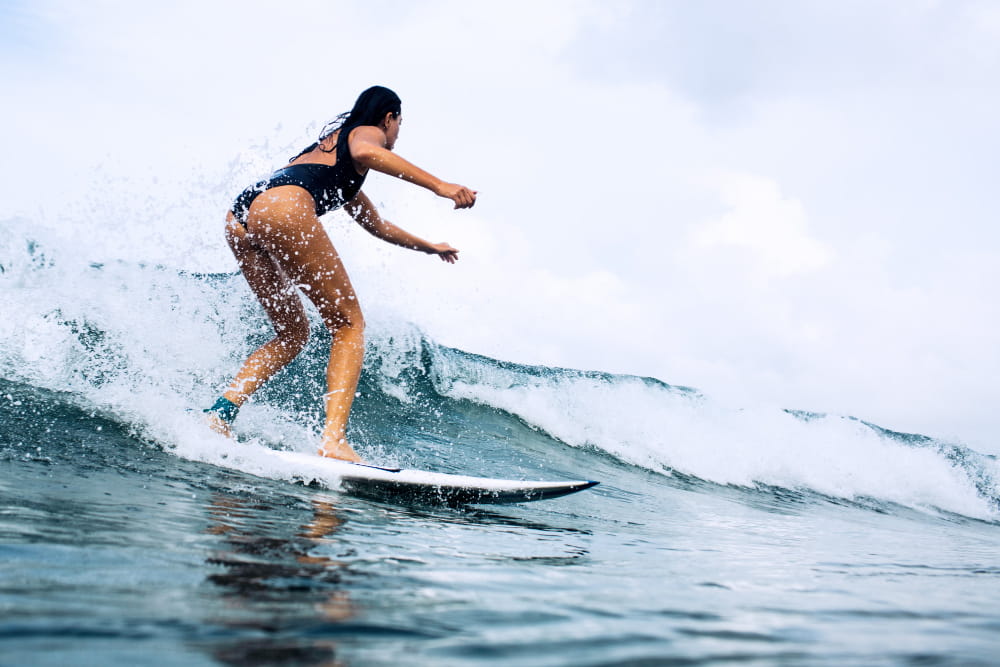
The most common mistake is to position yourself too late in relation to the wave’s movement. This late positioning condemns you to react to events rather than anticipate them, turning every attempt at take-off into a lost battle against the breaking wave.
Manifestations of this Error
Visible symptoms: You start paddling when the wave is already upon you, you systematically end up in the foam, you never have enough time to take off calmly.
Technical consequences: Rushed and unbalanced take-off, ineffective paddling due to lack of time, stress and tension that disrupt performance, missed waves due to lack of anticipation.
Impact on progress: Technical stagnation due to bad habits, loss of confidence due to repeated failures, premature exhaustion due to unnecessary effort.
Solutions and Corrections
Develop anticipation: Observe the wave series for 10 minutes before entering the water. Identify patterns, count intervals, anticipate the next waves. This active observation develops your ability to anticipate.
Proactive positioning: Get into position 30 seconds before the targeted wave arrives. Use lulls to reposition yourself, anticipate the necessary movements, and prepare your angle of approach.
Early wave reading: Identify promising waves as soon as they form on the horizon. Analyse their direction, speed, and breaking potential. This early reading gives you the necessary time advantage.
Correction Exercises
Observation training: Spend 15 minutes observing without surfing, time the intervals between sets, identify quality waves. This practice develops your ocean intelligence.
Positioning simulation: Practise positioning yourself for waves you won’t catch. This pressure-free simulation perfects your timing and anticipation.
Mistake #2: Sluggish and Ineffective Rowing
The Problem: Lack of Power and Technique
A weak paddle, lacking conviction and technique, is the second major cause of failure at take-off. This ineffective paddle does not generate the speed necessary to match and then exceed the speed of the wave, which is essential for a successful take-off.
Manifestations of this Error
Technical symptoms: Slow and shallow arm movements, irregular rhythm, rapid breathlessness, insufficient speed at the critical moment.
Direct consequences: The wave passes under you without carrying you, take-off impossible due to lack of speed, premature exhaustion due to inefficiency, frustration due to repeated failures.
Vicious circle: Failure leads to discouragement, discouragement reduces commitment, reduced commitment exacerbates the inefficiency of the paddle stroke.
Solutions and Corrections
Optimised rowing technique: Immerse your hand completely in the water, pull the water backwards with force, maintain a steady but sustainable pace. Your hand should act like an effective paddle.
Power development: Work on your specific physical condition: swimming, core exercises, shoulder and back strengthening. This physical preparation directly improves your rowing.
Total mental commitment: Row with conviction and determination, visualise your success, and give your all with every attempt. Mental commitment amplifies physical efficiency.
Acceleration timing: Start slowly to get into position, accelerate gradually, and sprint when the wave catches up with you. This effort management optimises your energy.
Strengthening Exercises
Pool training: Swim the crawl regularly to develop technique and endurance. Focus specifically on pulling power and coordination.
Dry rowing: Practise rowing movements on your board on dry land. This repetition develops muscle memory and perfects technique.
Mistake #3: Poorly Directed Gaze
The Problem: Impaired Vision that Disrupts Balance
Looking in the wrong direction is a subtle mistake, but one with major consequences. Looking down, at the board or at the foam disrupts your balance, throws off your take-off and deprives you of essential visual information.
Manifestations of this Error
Typical behaviours: Staring at the board during take-off, watching the foam coming in, looking down out of apprehension.
Impact on balance: Forward imbalance, messy take-off, loss of spatial awareness, frequent falls forwards.
Impact on performance: Lack of information about the wave’s movement, inability to anticipate the direction to take, visual stress that disrupts execution.
Solutions and Corrections
Look towards the horizon: While paddling, keep your head up and your gaze directed towards the horizon or the shoulder of the wave. This position optimises your balance and awareness.
Peripheral vision: Develop your peripheral vision to perceive your surroundings without moving your head. This ability improves your spatial awareness.
Visual anticipation: Look where you want to go, not where you are. This visual anticipation naturally guides your body in the right direction.
Gradual confidence: Develop your confidence to dare to look ahead. This confidence is gained through repetition and gradual success.
Correction Exercises
Eye training: Practise take-off on land while keeping your eyes fixed on a distant point. This repetition develops good visual habits.
Balance exercises: Work on your balance on different surfaces while keeping your eyes horizontal. This practice strengthens your natural stability.
Error #4: Incorrect Rail Entry
The Problem: Poor Grip Causing Instability
Incorrectly gripping the rails during take-off is a major technical error that destabilises your board and compromises your ability to stand up. This poor grip causes instability, loss of control and frequent falls.
Manifestations of this Error
Poor grip: Hands too far apart or too close together, grip too weak or too tight, hand position unsuitable for the shape of the board.
Technical consequences: Board unstable during take-off, loss of directional control, lateral imbalance, falls due to lack of stability.
Effects on confidence: Apprehension about take-off, tension that exacerbates the problem, loss of fluidity in execution.
Solutions and Corrections
Optimal hand position: Place your hands flat on the rails, at chest level, shoulder-width apart. This position provides stability and optimal control.
Balanced pressure: Apply firm but relaxed pressure, distribute the force between both hands, and adjust the pressure according to the movements of the wave.
Hand-body coordination: Synchronise the movement of your hands with the straightening of your body. This coordination improves the fluidity and efficiency of the take-off.
Adapting to the board: Adjust your grip according to the width and thickness of your board. Each board requires specific adaptation of technique.
Advanced Exercises
Repetition on land: Practise take-off on your board placed on the ground. Perfect your hand position, the pressure exerted and the coordination of your movements.
Board variations: Practise on different types of boards to develop your adaptability and refine your grip technique.
Mistake #5: Inappropriate Recovery Timing
The Problem: Too Early or Too Late
The timing of your take-off determines whether you succeed or fail. If you take off too early, you’ll lose the wave; if you take off too late, you’ll end up in the foam.
Manifestations of this Error
Premature recovery: You stand up before you have enough speed, the wave passes under you, and you fall back onto the board without having surfed.
Late stand-up: You stand up when the wave has already broken, you go straight into the foam, and it’s impossible to surf the shoulder.
Fatal hesitation: You hesitate at the critical moment, and this indecision causes you to miss the optimal timing, and the opportunity vanishes.
Solutions and Corrections
Signal recognition: Learn to identify the signals that indicate the optimal moment: feeling of lift, acceleration of the board, change in the slope of the wave.
Developing instinct: Cultivate your instinct through repetition and observation. This timing becomes more refined with experience and gradually becomes intuitive.
Commit without hesitation: Once you’ve made your decision, commit fully without hesitation. Hesitation at the critical moment guarantees failure.
Adapt to conditions: Adjust your timing according to conditions: fast waves (earlier timing), slow waves (later timing).
Development Exercises
Active observation: Watch other surfers and analyse their timing when standing up. This observation will enrich your understanding of optimal timing.
Progressive repetition: Start with easy waves to develop your timing, then progress to more difficult conditions.
Mistake #6: Unbalanced Body Position
The Problem: Poor Weight Distribution
An unbalanced body position during take-off compromises your stability and control. This mistake leads to frequent falls and chaotic take-offs.
Manifestations of this Error
Typical imbalances: Weight too far forward (forward falls), weight too far back (loss of speed), lateral imbalance (sideways falls).
Technical consequences: Unstable take-off, loss of directional control, repeated falls, inability to surf the wave.
Psychological impact: Loss of confidence, apprehension about take-off, tension that exacerbates imbalance.
Solutions and Corrections
Centred position: Keep your weight centred on the board, distribute it evenly between the front and back, and maintain lateral balance.
Bend your knees: Bend your knees to lower your centre of gravity; this position improves your stability and control.
Progressive coordination: Develop coordination between the different parts of your body. This harmony improves the fluidity of your take-off.
Dynamic adaptation: Constantly adjust your position according to the movements of the wave. This continuous adaptation maintains your balance.
Correction Exercises
Balance work: Practise balancing on different unstable surfaces. This preparation improves your proprioception and stability.
Movement repetition: Repeat the take-off on the ground, focusing on your body position. This repetition develops muscle memory.
Mistake #7: Lack of Commitment
The Problem: Hesitation That Sabotages Execution
Lack of commitment is the most subtle but often the most devastating mistake. This hesitation, this restraint at the critical moment, sabotages technical execution and turns promising attempts into failures.
Manifestations of this Error
Hesitant behaviour: Hesitant rowing, timid recovery, abandoning during take-off, doubt at the critical moment.
Technical consequences: Sluggish and ineffective execution, timing disrupted by hesitation, loss of speed due to lack of conviction.
Vicious circle: Failure reinforces hesitation, hesitation leads to more failure, confidence gradually erodes.
Solutions and Corrections
Building confidence: Build your confidence through gradual successes on easy waves. This confidence will then transfer to more difficult conditions.
Total mental commitment: Make clear decisions and commit to them fully. Once you’ve committed, see it through to the end without hesitation.
Acceptance of risk: Accept that failure is part of learning. This acceptance unlocks your potential and reduces pressure.
Positive visualisation: Visualise your success before each attempt. This mental preparation improves your commitment and execution.
Mental Strengthening Exercises
Gradual progression: Gradually increase the difficulty to build your confidence without setting yourself up for failure.
Analysis of successes: Analyse your successes to identify the factors that led to them. This analysis will boost your confidence and improve your technique.
Video Resources for Correcting These Errors
Specialised Videos on Take-off Errors
“7 ERREURS DE TAKE OFF (Et comment les corriger) – Tutoriel surf débutant” (YouTube – Waved) : Comprehensive analysis of common errors with concrete solutions and practical demonstrations.
“7 ERREURS FRÉQUENTES AU TAKE OFF ET COMMENT LES CORRIGER” (YouTube) : Detailed guide to the most common errors with proven correction methods.
“Tuto surf : les 5 plus grosses erreurs au take off” (YouTube) : Focus on major errors that sabotage progress, with technical solutions.
Technical Improvement Videos
“The 3 biggest pop-up mistakes surfers make” (YouTube – Longboard Sessions) : Expert analysis of pop-up errors with personalised coaching.
“These 3 Mistakes Are DESTROYING Your Pop Up” (YouTube) : Identification of critical errors that are ruining your take-off, with immediate corrections.
“How to angle the take-off and common mistakes” (YouTube – Ombe Surf) : Angled take-off technique and associated errors with in-depth analysis.
Advanced Coaching Resources
“Surfing 101: HOW TO Take Off Like a Pro and Catch More Waves” (YouTube – Josh Kerr) : Professional take-off techniques with expert advice.
Playlist “How to Take Off” (YouTube) : Complete collection of tutorials on take-off with different technical approaches.
Personalised Correction Plan
Diagnosis of your Errors
Self-assessment: Identify which errors affect you the most. Be honest in your analysis to effectively target your correction efforts.
Prioritisation: Focus on a maximum of 2-3 errors at a time. This focused approach improves the effectiveness of your progress.
Progress tracking: Keep a log of your sessions, noting which errors have been corrected and which ones persist. This analysis guides your training.
Correction Method
Progressive correction: Work on one error at a time, mastering the correction before moving on to the next. This method avoids cognitive overload.
Conscious repetition: Consciously repeat the correct techniques until they become automatic. This repetition develops new habits.
Patience and perseverance: Corrections take time and patience. Accept temporary setbacks as a normal part of the process.
Conclusion
These seven classic mistakes sabotage the progress of thousands of surfers every day. Identifying and systematically correcting them will revolutionise your take-off and unlock your potential. Every mistake you correct brings you closer to the smooth, consistent surfing you dream of.
Remember that these mistakes are normal and universal. All surfers, even professionals, made them when they were starting out. The difference lies in the ability to identify, accept and methodically correct them.
Armed with this knowledge and the appropriate video resources, you now have the tools to turn your weaknesses into strengths. Your take-off becomes your asset, your progress accelerates, and your enjoyment increases tenfold.
Surfing awaits you with successful take-offs and perfectly surfed waves. These corrections pave the way for technical excellence and the authentic pleasure of accomplished surfing.

5 Things to do in Corralejo, Fuerteventura during your Surf Stay
Lire la suite