



2. How to choose your surfing accessories when you’re just starting out?

4. How to adapt to the practice spot?
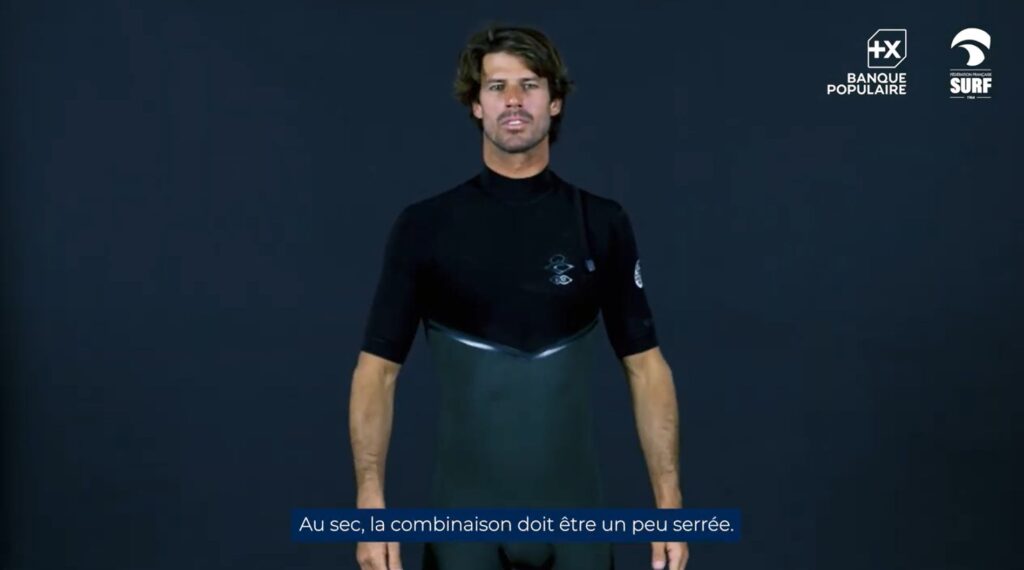
A wetsuit is much more than just an accessory: it’s like a second skin. It protects you from the cold, wind and salt, while offering the freedom of movement that is essential for surfing. The choice of model depends above all on the water temperature, the season and the right size.
Contenus de la page
🌊 Special for beginners: method for threading and size control
When you’re just starting out, putting on a wetsuit can quickly become a bit of a struggle! However, with the right method, everything becomes much easier.
First of all, don’t rely on diving wetsuits because in surfing, older or entry-level models often have the zip at the back. On wetsuits for advanced levels, the zip is usually at the front (“front zip”).
If in doubt, look at where the knee reinforcements are: they indicate the correct way to put them on!
To put it on, proceed as you would with a sock: start by adjusting the calves, then the thighs, making a hem to fit snugly around the waist before passing the upper body and arms through. Ensure that the fabric is flat against the skin, without excessive folds.
The ideal size is easy to recognise: there should be little free space under the arms and no flapping. If the wetsuit fills with water every time you fall, it is too big.
The principle of neoprene is based on a thin film of water trapped between the wetsuit and the skin: this thin layer warms up thanks to your body temperature and acts as a natural insulator.
A wetsuit that is too loose allows cold water to enter, completely negating this protective effect. It is therefore better to have a wetsuit that is slightly fitted than one that is too loose.
Why wear a wetsuit?
A wetsuit is essential equipment for staying comfortable and performing well in all conditions.
Made from neoprene, it acts as a thermal barrier, trapping a thin layer of water that warms up on contact with the body. This insulation allows you to surf for longer without feeling cold.
It also protects the skin from rubbing against the board, UV rays and wind.
Which combination for which season?
The type of wetsuit depends directly on the water temperature. Here are some guidelines to keep in mind:
-
🌞 Summer (warm waters): light wetsuit or shorty (approx. 2 mm thick).
-
🍂 Spring/Autumn (temperate waters): 3/2 mm full wetsuit, offering a good balance between warmth and flexibility.
-
❄️ Winter (cold water): 4/3 mm or 5/4 mm wetsuit, sometimes with accessories (gloves, hood, booties).
Adapting your equipment to the season ensures greater comfort and less fatigue during your session.
The importance of neoprene thickness
Neoprene is the key material in a wetsuit. Its thickness determines the warmth and flexibility of the garment.
The thicker the neoprene, the more heat it retains — but it also becomes slightly less flexible.
The most common thicknesses are:
- 2 to 3 mm → for temperate waters (summer)
- 4 to 5 mm → for colder waters (winter)
Choosing the right thickness means finding the right balance between thermal insulation and freedom of movement.
Choosing the right size wetsuit
A good fit is essential for the wetsuit to be effective.
When dry, it should feel slightly tight: the neoprene will soften once wet.
A wetsuit that is too large will let water in and lose its thermal efficiency.
Tip: check that you can move your arms and shoulders freely without excessive creasing.
Conclusion
Choosing the right wetsuit means combining warmth, comfort and freedom of movement.
Whether you surf in the height of summer or in the depths of winter, a wetsuit suited to the water temperature will allow you to enjoy the waves all year round, without ever feeling cold.





Where to learn to surf in Fuerteventura, Canary Islands?
Lire la suite