


How much does a surfing holiday cost? An investment in your child’s development

Colo Surf: How does it transform your children and teenagers?
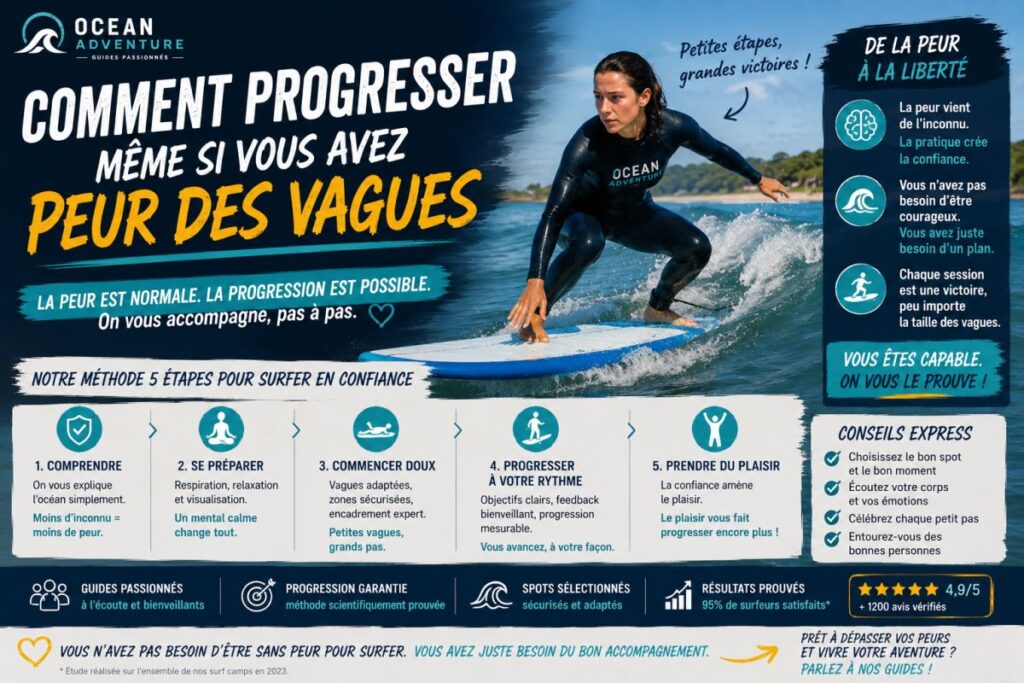
The fear of waves remains a well-kept secret in the world of surfing. Rarely discussed, it stands in stark contrast to the image of the intrepid, serene surfer that you might see elsewhere. Yet this apprehension is universal.
Even the most experienced surfers sometimes feel a rush of adrenaline when faced with a set of waves that’s bigger than expected.
If you’re feeling this fear, there’s one crucial thing you should know: this fear is normal, healthy and, above all, it doesn’t mean you’ll never make progress. It simply means you don’t yet have all the tools you need to face the ocean with confidence. At Surf & Yoga Camp Hossegor, we have developed a specific approach to turn this apprehension into a driving force for progress.
Contenus de la page
Understanding the origins of fear
Fear of the ocean stems mainly from a fear of the unknown and a loss of control. When you do not understand why a wave suddenly gets bigger, why a current is sweeping you away, or why you cannot get out of the breaking zone, your brain triggers a mechanism of intense stress. This phenomenon is well documented in sports physiology, which shows that stress often results from a perceived loss of control when faced with an unpredictable environment[1].
The key, therefore, is not to force yourself to tackle ever-bigger waves without proper preparation. The real solution lies in understanding the ocean to demystify it. This is precisely the foundation of our teaching philosophy and the first step towards feeling more confident in the water.
“We are not afraid of what we understand. Knowledge is the best antidote to fear in the water.”
Theory as the first line of defence against apprehension
Even before you set foot in the water, we’ll give you the essential tools to better understand your environment. Our theory lessons will equip you with knowledge that will radically change the way you view the ocean. For example, you’ll learn how to identify currents, particularly rip currents, from the beach. Realising that these lateral currents don’t drag you out to sea but along the shore helps to allay a great deal of anxiety.
You’ll also learn to read the tides and understand how they affect the shape and power of the waves. This knowledge enables you to choose the ideal time to get in the water, depending on your ability and the type of waves you want to surf. Finally, you’ll discover how to anticipate the arrival of wave sets and position yourself correctly to catch them. This ability transforms a situation where you’re at the mercy of the waves into one where you’re in real control of your environment, which significantly reduces stress.
The Casernes area: a reassuring environment
Where you learn to surf plays a crucial role in managing your fear. At Surf & Yoga Hossegor, we don’t rush you straight into Hossegor’s impressive barrels. We prefer Casernes Beach in Seignosse, a wild spot where the waves build gradually and the wide patches of whitewash provide the ideal environment for you to build your confidence step by step.
This spacious, quiet spot allows you to progress at your own pace, without feeling the pressure of other people’s stares. Our experienced instructors are with you at all times in the water, guiding you on the waves and reassuring you as you ride the sets. This personalised support is essential to help you overcome your fears in complete safety.
Yoga and breathing: powerful tools for regaining a sense of calm
Fear triggers an immediate physiological reaction: your heart rate increases, your breathing becomes laboured and your muscles tense up. In this state of tension, it becomes impossible to execute a smooth take-off or make clear decisions in the water. This reaction is perfectly explained by neuroscience, which shows that controlling your breathing is a key way of regulating your emotional response and stress[2].
This is where our functional yoga programme really comes into its own. Beyond improving mobility, yoga teaches you to control your breathing. The Pranayama (conscious breathing) exercises we practise every morning provide you with a practical tool for calming your nervous system at will, even when faced with a series of impressive waves.
| The technique | How she helps in the water |
|---|---|
| Deep abdominal breathing | Slows down your heart rate before tackling a series of waves. |
| A long, controlled exhalation | Relieves muscle tension following a fall or a ‘workout’. |
| Cardiac coherence | Maintains a state of calm and clarity throughout the session. |
“Knowing how to breathe in the water means regaining control. And regaining control means you’re really starting to surf.”
As you’ll have realised, being afraid of the waves will never stop you from becoming an accomplished surfer. It simply requires the right support, a welcoming environment and the right tools to manage your emotions and your technique. That’s exactly what we offer at Surf & Yoga Hossegor. Come and face your fears with us, on the gentle, generous waves of Les Casernes!