You’re paddling hard, you manage to catch a few waves, but you’re left with that frustrating feeling that you’re not making any progress. There’s nothing more discouraging than coming back from a surf trip feeling as though you’ve spent hours in the water without really improving your technique. Don’t worry, you’re not the only one in this situation.
Having coached hundreds of aspiring surfers, we’ve noticed a simple truth: most of them fail to progress not because of a lack of talent or motivation, but because they keep repeating bad habits in an environment that isn’t suited to their level. The good news is that this lack of progress isn’t inevitable.
Surfing more doesn’t automatically mean you’ll improve any faster. Spending four hours in the water repeating the same mistakes only serves to reinforce bad habits.
Surfing is a technical sport that requires the right environment, personalised feedback, a keen understanding of the ocean and a body that’s ready for the challenge.
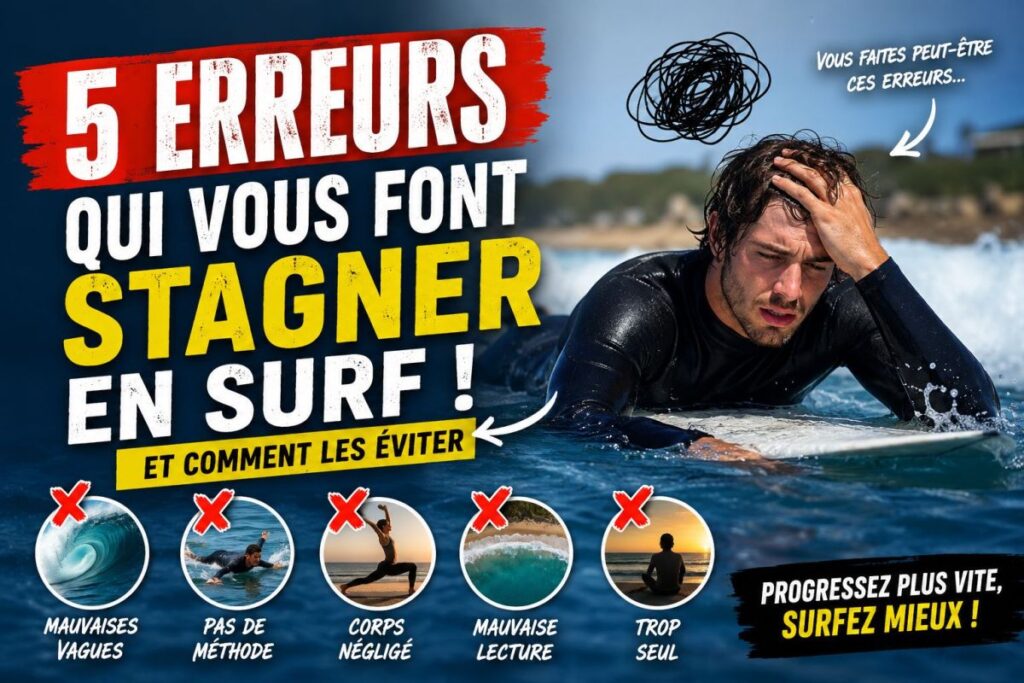
Here are the five most common mistakes that hold back your progress, along with the approach we take at the Hossegor Yoga & Nature surf camp to help you avoid them.
1. Trying to ride waves that are too difficult for your level
This is undoubtedly the most common mistake made by beginner surfers. You all dream of perfect, hollow and powerful waves, like those at the legendary spots in Hossegor that you see in videos. The problem is that these challenging waves are completely unsuitable for building a solid foundation.
When faced with a wave that’s too fast or too powerful, stress often gets the better of you. You start paddling too late, you miss your position, you stand up in a hurry and fall back on defensive reflexes. In the end, you spend more time struggling in the whitewater than learning to ride the wave.
Progress in surfing comes from repeating the right movements in a controlled environment. The gentler and more predictable the wave, the more time you have to work on your take-off and your positioning on the board, your ability to build up speed right from the start, as well as reading your trajectories and your footwork.
It is precisely for this reason that we favour the Casernes spot in Seignosse. Its sandbanks create gentle, forgiving waves, ideal for learning to surf without fear. Always bear in mind this essential truth:
“Small waves often make the best surfers.”
2. Thinking that surfing a lot is enough to improve
The illusion that ‘I’ll go surfing every day and I’ll eventually get the hang of it’ is a persistent one. However, surfing doesn’t always work that way. If you keep riding wave after wave, falling over and over again without ever understanding the cause of your mistakes, you risk making no progress for a long time.
Was your gaze misdirected? Was your timing off? Was your stroke lacking in efficiency? When you’re alone in the water, it’s difficult to take an objective look at these issues. That’s where coaching makes all the difference.
High-quality coaching enables you to correct mistakes straight away, adapt exercises to your body type and understand what’s holding you back. To speed up this process, we systematically incorporate video analysis into our teaching method. This tool is incredibly powerful as it shows what you’re actually doing, rather than what you think you’re doing. A take-off that you imagine to be perfect may reveal a gaze drifting downwards, poor rear weight distribution or standing too far forward on the board.
“Sometimes, a single technical adjustment can make all the difference.”
Seeing these details enables you to make an immediate adjustment that will resolve the issue as early as the next session.
3. Neglecting your body and its mobility
From the outside, surfing may seem fluid and effortless. Yet it is a physically demanding sport that engages the whole body, going far beyond mere arm strength. Many surfers head out onto the water with tight shoulders, a stiff back, limited hip mobility and weak core strength. This stiffness leads to awkward compensatory movements that hold your technique back: you stand up more slowly, lose stability, tire quickly and are at greater risk of injury.
That is why we have built our camp around the Mind & Body experience. Our functional yoga programme, specially designed for surfing, focuses on four key areas:
| Profit |
Impact on your surfing |
| Joint mobility |
A smoother and faster take-off |
| Balance and core strength |
Greater stability on the board |
| Breathing exercises |
Calm and clarity in TV series |
| Active recovery |
Putting in one training session after another without getting worn out |
“A fit and well-maintained body is the key to better and more enjoyable surfing.”
This approach is based on studies in sports physiology which demonstrate the importance of joint mobility and core stability in improving sporting performance and reducing injuries[1].
4. Not learning to read the ocean
Understanding the ocean is undoubtedly the greatest possible catalyst for progress. A good surfer doesn’t just look at a single wave; they observe the whole spot. Positioning yourself in the wrong spot, exhausting yourself paddling against a current, ignoring the tidal cycle or misinterpreting the configuration of the sandbanks are all mistakes that waste your precious energy and cause you to miss out on the best opportunities.
To make faster progress, you need to learn to observe the conditions before you even get in the water. The questions you should ask yourself whilst still on the beach are simple: where are the best sets breaking today? How does the spot change as the tide rises or falls? Where is the current and how can you use it to your advantage?
That’s why we include theory lessons as part of our surf camp. We’ll teach you how to read a weather map, interpret the swell and analyse your surroundings. This comprehensive understanding of the marine environment will save you precious time and make you truly independent during your future sessions, wherever in the world you are.
This approach is supported by oceanographic research which shows how an understanding of local phenomena enhances surfers’ safety and performance[2].
5. Wanting to make progress on your own, in your own little corner
The internet is full of tutorials and instructional videos on surfing. Whilst these resources can be inspiring, they all share the same flaw: they are generic. Yet every surfer is unique. Your potential for improvement depends on your ability, your fitness, your flexibility, your understanding of the waves and your experience of the ocean. Trying to apply a one-size-fits-all approach is often doomed to failure.
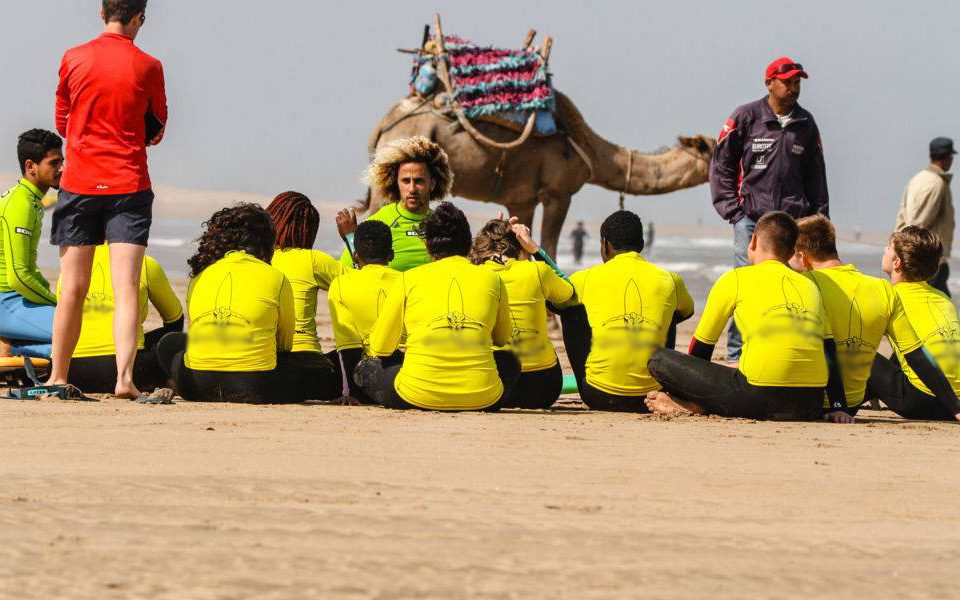
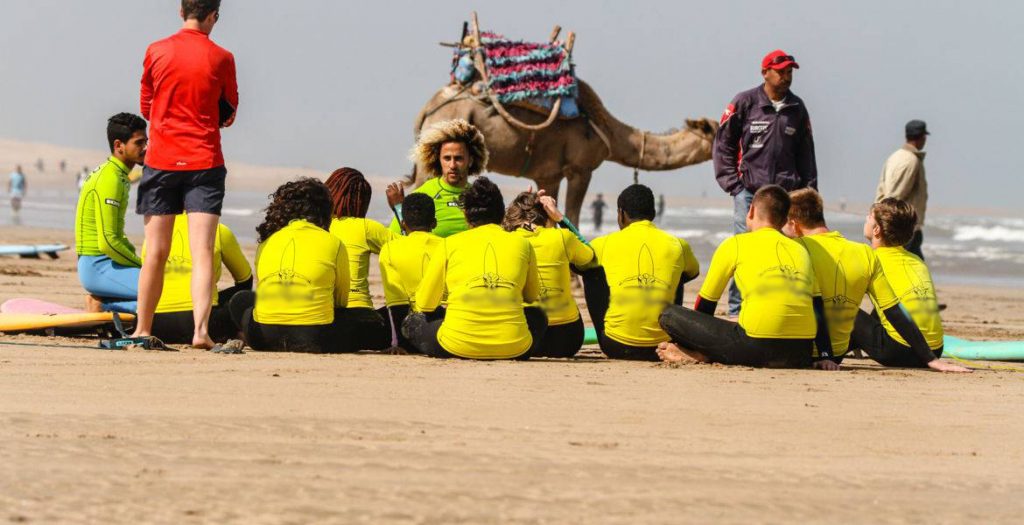
Tailored coaching makes all the difference. Our instructors, who work with small groups of between 5 and 8 people, quickly identify your specific difficulties and focus on the waves that will help you improve. For some, this will involve working on managing fear; for others, it will be about stroke timing or upper-body posture.
“It’s this highly personalised approach that makes the difference between stagnating for entire seasons and taking your surfing to the next level in just one intensive week.”
So, how can we really make progress?
Ultimately, making rapid and lasting progress in surfing requires much more than just a board and a bit of determination. You need to fulfil several conditions centred around six key pillars: surfing waves suited to your actual ability, benefiting from personalised coaching enhanced by video analysis, developing a detailed understanding of the ocean and the weather, preparing your body through mobility exercises and yoga, adopting a healthy diet to support your training and recovery, and practising regularly but intelligently, not just intensively.
At Surf & Yoga Hossegor, we have designed the ultimate experience to meet these requirements: premium coaching, a holistic approach to body and mind, and a friendly, supportive atmosphere in the heart of the Landes forest. Join us for a personal and sporting adventure that will transform the way you surf.
Hossegor Surf Camp: Yoga & Nature