



Kitesurfing is an exciting outdoor activity that can be learned at any age. If you are looking for a new challenge or a way to disconnect from your daily routine, why not learn how to kitesurf?
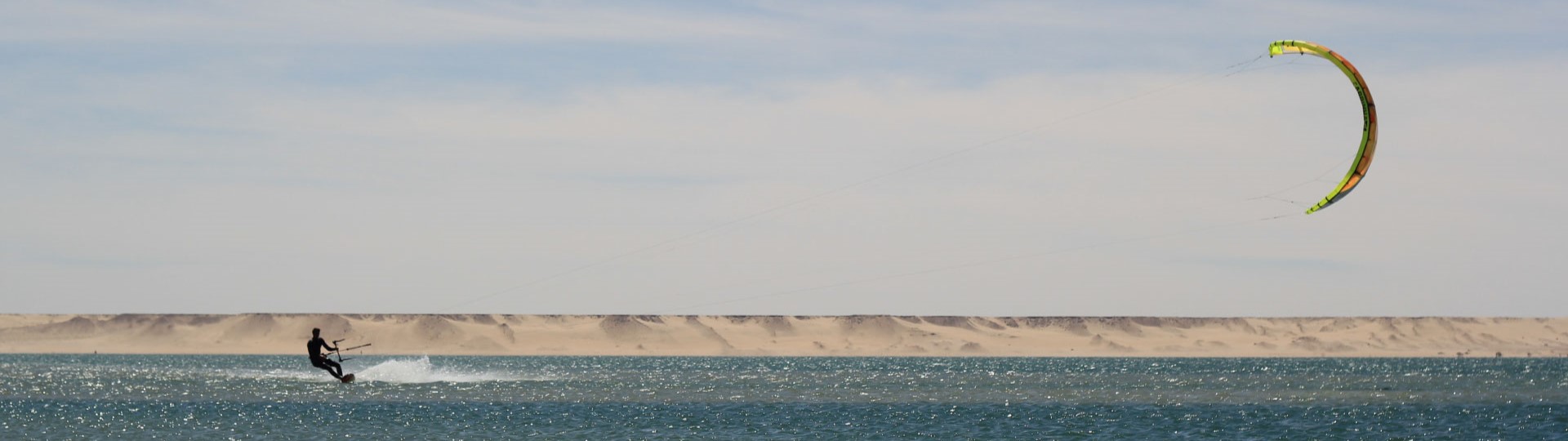
In this comprehensive guide, we will show you the steps you need to take to learn how to kitesurf effectively and safely. We will cover everything from the necessary equipment to the different techniques you need to master to become an experienced kitesurfer.
Learning kitesurfing is not difficult!
Are you keen to try kitesurfing with your family, friends, partner or on your own?
Follow our guide and discover our best kitesurfing schools to learn kitesurfing safely and progress to master the basics of kitesurfing and have fun! For all budgets, from France to Morocco to Dakhla, via Spain with Tarifa or even the Canary Islands!
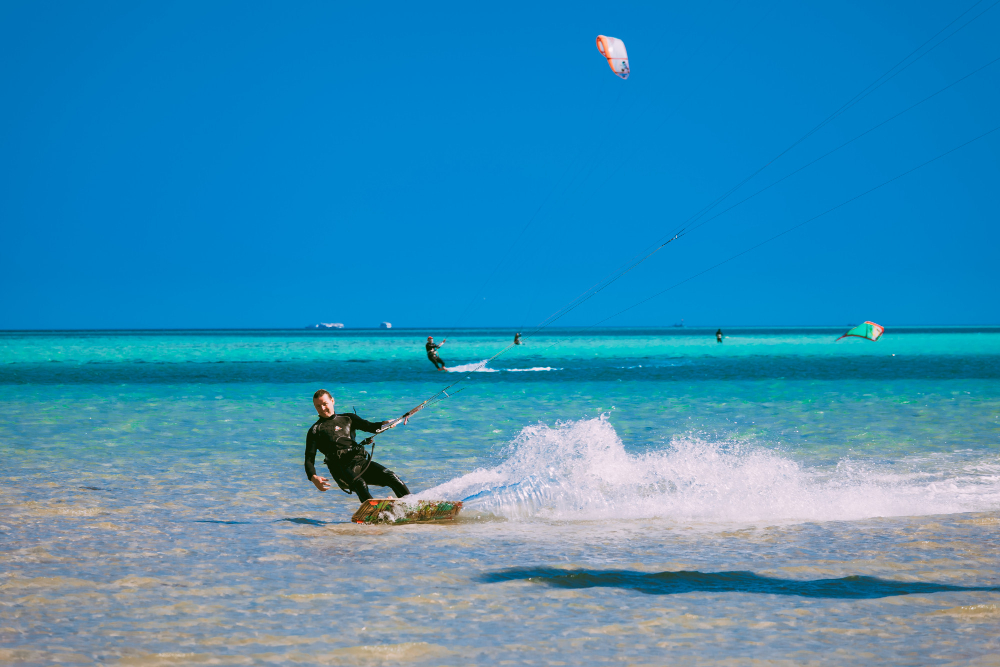
Learning kitesurfing on your own: not such a good idea after all!
It is possible, but highly inadvisable! You need to take into account gusts of wind and other dangers and parameters of this sport. That is why, from a safety point of view, we strongly recommend starting kitesurfing with lessons at a school. Discover our kitesurfing schools in France (Brittany), Spain (Fuerteventura and Tarifa), and Morocco (Dakhla).
We recommend taking 12 hours of kitesurfing lessons to get started, which will allow you to set goals such as becoming independent and reaching the Waterstart level before you can consider that you have mastered the basics and are ready to move on to the next intermediate level.
After these first 6 lessons, you will have only one thing in mind: more kitesurfing! Now that you have the basics, the secret to progress is practice. We recommend our 3 kitesurfing courses (6 hours) to become independent and enjoy even more thrills.

Intermediate Level
Tacking and Jibing
Tacking and jibing manoeuvres are an integral part of progressing in kitesurfing. These techniques allow you to change direction smoothly and in a controlled manner. Learning how to perform these manoeuvres with precision will open up new possibilities during your kitesurfing sessions.
-
Tacking, also known as a windward turn, involves changing from one sailing course to another by crossing the wind. To tack, start by easing off the tiller to release the power from the wing. Then pivot your wing forward, letting the wind pass behind you. Change feet on the board and put power back into the wing on the other side to continue on your new course.
-
Jibing, on the other hand, is turning into the wind, allowing you to maintain your course while changing direction. To jibe, start by sending the wing backwards to build up power. Pivot your body and board in the new direction while keeping the kite under tension. Once the jibe is complete, power up the kite again to resume sailing.
-
When learning to tack and jibe, be sure to choose a clear and safe area, away from other kitesurfers and obstacles. Start by practising these manoeuvres in moderate wind conditions and on a board suited to your skill level.
-
Focus on the timing and coordination between your movements and those of the kite. Maintain precise control of the bar to adjust the power of the kite during the manoeuvre. Practise these movements regularly to improve your fluidity and confidence.
-
When performing tacks and jibes, remember to maintain a balanced position on the board, with your knees bent and your gaze directed towards the new direction. Anticipate changes in the power of the kite and adjust your position on the board accordingly.
-
Continue to practise and explore different variations of tacks and jibes, such as the carving jibe or downloop tack, to expand your repertoire of manoeuvres.
-
With practice and perseverance, you will master the techniques of tacking and jibing, allowing you to explore new horizons and enjoy your kitesurfing sessions to the fullest.
Wind windows
Hello everyone, welcome to this new tutorial. Today we are going to talk about the window ahead. Before we go any further, it is essential that you fully understand and master the terms “upwind” and “lifting” in order to understand what the window ahead is. So, as a reminder, in the scenario shown here you see here, you have a kite at noon above the pilot, the wind is blowing behind the pilot, everything behind the pilot of the kite wing will be upwind in relation to him, everything in front of the pilot will be downwind, upwind, downwind, in itself, it doesn't mean anything, we always talk about an upwind or downwind position in relation to something else, so here in case, we are talking in relation to the pilots. To answer the question, ‘What is the window in front?’, there are not 36 answers. Look no further, it's
case in point. The window in front is simply the space in which your kite flies. This window in front consists of two main parts, namely the edge of the window and the power zone. So, to locate the board of net, imagine that the wind is blowing at your back and then imagine a rainbow passing over you. This rainbow forms an arc that we is called the window edge. On this window edge, we will place numbers like on a clock face so that we can find our bearings. You will find 9 o'clock at the left end, followed by 10 o'clock, 11 o'clock, 12 o'clock, also called the zenith, which is above your head, then 1 o'clock, 2 o'clock, and 3 o'clock at the right end of the window in front of you. If we look at it from a real-world perspective, it is exactly the same: the 9 o'clock school heads
slowly towards noon and finally ends its journey at 3 o'clock, where it is alone on the right. What you need to remember about the window edge is that it is the least powerful part of the window in front of you, that the power is the same as if your kite were positioned at 9 o'clock, 12 o'clock or 3 o'clock. Finally, the board of net is the place that your kite is constantly looking for. It is like a magnet at the edge of the window. It looks for it because that is where it will be most stable, where it will feel good. So, once you have found the edge of the window on the ground when positioning a wing for take-off, leave this wing at the edge of the window. Normally, if it is well adjusted and the wind is not too unstable, it should remain balanced. Finally, 9 o'clock and 3 o'clock are the places on the edge of the window that we use for a safe wing take-off. The second area of the front window is what we call the power zone.
power zone. As its name suggests, this zone is where the power is located, and it is simply found on the entire leeward side in relation to the pilots. This power zone does not deliver the same power everywhere; the power will be crescendo, meaning that it increases gradually as the wing moves away from the edge of the window. So, if we you look at it from the side, the maximum power zone will be in the red zone located downwind of the pilot. When I fly a model, if I fly it in the left zone of the window in front of me, I will move to the left; if I fly it in the right zone, I will move to the right. Now, if you understand the difference between the edge of the window and the power zone, you will understand that taking off with a kite wing is always done from 9 o'clock or 3 o'clock, and you climb gently towards noon along the edge of the window.
On the other hand, if you position your sail in the flat power zone and raise your kite above the power zone, you will be pulled away violently and have a serious accident during take-off. We often notice that kite surfers have a little trouble finding the edge of the window. To find the edge of the window, you just need to read the behaviour of your kite, which, once again, is a magnet at the edge of the window. tells you where it is. It wants to go there, so if your kite is runaway, limp, lacking consistency and seems to be drifting downwind on its own, it is probably because the wind window edge is downwind. On the other hand, if your kite is a little too powerful and pushing hard against your take-off partner, it means that the wind window edge is located more upwind, towards where your kite is pushing. Don't hesitate to spend time watching the kites fly, observing their behaviour and analysing it. A good
understanding of the window and a good understanding of how a kite behaves is the best way to stay safe and improve. So, it's never a waste of time, and take as much time as you need. Good luck for the future. Feel free to join the Facebook group and Wang Kiteboarding and subscribe to the YouTube channel to follow all the latest tweets. See you soon!
Congratulations, you have reached the intermediate level in kitesurfing! At this stage, you have already mastered the basics and are comfortable with basic manoeuvres such as waterstarts and sailing on different courses. Now you are ready to deepen your skills and develop your riding style. In this stage, we will guide you through the different stages of progression to become an even more accomplished and confident kitesurfer.
Basic security:
Before continuing your progress, it is essential to review the basic safety rules. Make sure you know how to quickly disconnect your wing, retrieve your board and perform safety procedures in case of a problem. Also keep in mind the rules of priority on the water and be aware of your surroundings.
Advanced manoeuvres:
At this stage, you can start exploring more advanced manoeuvres such as jibing and tacking. These manoeuvres will allow you to change direction using the skills you have acquired so far. By practising these manoeuvres regularly, you will gain fluidity and control in your transitions.
Upwind sailing:
The aim of this stage is to develop your ability to sail upwind. Learn how to use the power of the wing effectively and adjust your sailing angle to maximise your progress against the wind. Practise zigzagging to optimise your upwind sailing and improve your speed and control.
Rules of priority:
As an intermediate kitesurfer, it is important to understand and respect the rules of right of way on the water. Learn to recognise other water users such as windsurfers, surfers and swimmers, and always give them priority. This will ensure safe and respectful riding with other riders.
Expanding your wind range:
At this stage, you can start exploring more varied wind conditions. Try sailing in stronger or weaker winds than you are used to. This will help you develop your ability to adjust your technique to different weather conditions and become a versatile rider.
Harness navigation and basic jumps:
To progress to an advanced level, it's time to explore harness flying. Learn how to adjust your harness properly and use the power of the wing to relieve your arms and improve your stability. You can also start experimenting with basic jumps using the power of the wing to gain height. Start with small jumps and progress gradually according to your comfort and skill level.
Strengthening your style:
At this stage, it's time to strengthen your sailing style. Work on your posture, balance and coordination to improve the fluidity of your movements. Try adding your own personal touch to your transitions and manoeuvres. Develop your own sailing style that sets you apart on the water.
Power control:
At this stage, you will need to refine your ability to control the power of your kite. Learn how to adjust the position of your kite in relation to the flight window to adjust the amount of power you use. Practise edging and depowering to modulate the pulling force of the kite according to the wind conditions.
Advanced jumps and tricks:
You are now ready to explore more advanced jumps and tricks. Start with basic jumps such as straight jumps and grabs. Then move on to more technical tricks such as 180-degree rotations, backrolls and frontrolls. Remember to always practise in open areas and use equipment that is suitable for your level.
Navigating the waves:
If you have access to spots with waves, it's time to explore wave riding. Learn how to read the waves, choose the right position and surf the waves smoothly. Experiment with different techniques to generate speed, perform bottom turns and cutbacks. Wave riding adds an exciting and dynamic dimension to your kitesurfing.
Practise with other riders:
To continue improving, it is beneficial to practise with other experienced riders. Exchange tips, observe their technique and take part in group freeride or freestyle sessions. This will allow you to broaden your horizons and discover new approaches to kitesurfing.
Be mindful of the environment:
As an intermediate kitesurfer, it is important to be aware of your surroundings. Respect local rules, avoid prohibited areas and be mindful of marine life. Help preserve the coastal ecosystem by adopting environmentally friendly practices.
Continue to train regularly, take lessons and participate in practice sessions to keep improving as an intermediate kitesurfer. Stay passionate, open to learning and continue to explore all the possibilities offered by this wonderful discipline. Kitesurfing is an endless adventure where every trip out on the water is an opportunity to surpass yourself and experience unforgettable moments. So grab your kite, feel the power of the wind and let yourself be carried away by the unique sensations of kitesurfing!
Dahab, Egypt: Dahab is known for offering more affordable rates compared to other kitesurfing destinations. Accommodation, kitesurfing lessons and daily living are generally cheaper here. In addition, the wind conditions are excellent, making it an attractive spot for kitesurfers.
Essaouira, Morocco: Essaouira is a popular kitesurfing destination in Morocco. It offers a relaxed atmosphere, affordable accommodation and competitive prices for kitesurfing lessons. The steady winds and vast beaches make it an ideal place for beginners and experienced riders alike.
Tarifa, Spain: Although Tarifa is a very popular spot for kitesurfing, it is possible to find affordable options, especially outside of the high tourist season. Youth hostels, equipment rentals and kitesurfing lessons often offer competitive rates.
Kitesurfing lessons
There are several options for learning how to kitesurf, but group or private lessons with a qualified instructor are often the most effective for beginners. You can find local kitesurfing schools by searching online or asking friends who already practise this activity.
Kitesurfing lessons usually include theoretical training on the different techniques for flying the kite, as well as practical sessions at sea or in shallow water. Instructors will guide you through the learning process and provide advice on safety and kitesurfing techniques.
Regular practice
As with any newly learned sport, regular practice is essential to improving your kitesurfing skills. The more you practise, the more confident you will become in your abilities and the more you will be able to explore new techniques and challenges.
In conclusion, kitesurfing is an exciting and rewarding activity that can be learned at any age. By following the steps outlined in this guide, you can learn how to kitesurf effectively and safely. So why not embark on this adventure today?
The best destinations for learning kitesurfing?
Fuerteventura, Canary Islands: This is a popular destination for kitesurfing and offers a variety of options for all budgets, from luxury hotels to youth hostels, kite camps and family apartments. Discover different types of kitesurfing holidays near the best kitesurfing spots, between Corralejo, El Cotillo and Sotavento.
reserve button
Dakhla
reserve button
ADVANCE
Welcome to the world of advanced kitesurfing, where you will push your limits and discover extraordinary new sensations. At this stage, you have mastered the basics of kitesurfing and are ready to venture into more advanced techniques and manoeuvres.
Each step of the progression we will cover will allow you to explore new horizons and become an accomplished kitesurfer. Get ready for moments of adrenaline and wonder!
Tacking :
Tacking is a fundamental manoeuvre in kitesurfing that involves changing direction by turning into the wind. This allows you to navigate efficiently in all directions and explore new spots. Learn to anticipate the right moment to tack based on wind and sea conditions. Master the coordination between your body movement, kite position and change of direction to execute smooth, controlled tacks. This technique will open up new perspectives in terms of navigation and possibilities on the water.
Practise tacking in moderate wind conditions and in open areas. Be patient and persistent, as this manoeuvre can be tricky at first. Practise regularly and analyse your performance to identify areas for improvement. With time and practice, you will be able to tack confidently and smoothly.
Basic jumps :
Basic jumps are one of the most exciting sensations in advanced kitesurfing. They allow you to gain altitude and experience a real feeling of freedom in the air. Start with simple jumps, using the power of your kite to propel yourself. Learn to control your landing by cushioning the impact with your legs. Gradually, you can experiment with more advanced tricks, such as grabs and rotations. Jumps are a fantastic way to push your limits and explore your creativity on the water.
Ensure you are comfortable with the waterstart technique and power control before attempting jumps. Practise in steady wind conditions and allow sufficient space to land safely. Remember to use appropriate equipment and follow safety rules. Start with modest jumps and progress at your own pace. Pay attention to your positioning and balance during jumps to maximise your height and control.
360s :
360-degree rotations are a natural progression after mastering basic jumps. This manoeuvre involves performing a complete rotation while in the air. The key to successful 360s is to combine the movement of your body with the movement of your wing.
Focus on coordinating your rotational movements with the timing of your kite to maintain balance and stability. Start with slow, controlled rotations and progress to faster, more fluid rotations. 360s add an artistic dimension to your kitesurfing style and allow you to push the boundaries of your creativity.
Before attempting 360-degree rotations, make sure you have mastered basic jumps and have good coordination between your body and your kite. Practise in open water and avoid obstacles. Pay attention to your positioning and balance throughout the rotation. Practise regularly to develop fluidity of movement and ease in 360s.
Free flying :
Free flying is the ultimate stage of advanced kitesurfing progression, where you push the limits of your freedom and creativity on the water. This phase allows you to explore customised tricks and acrobatic manoeuvres. You are free to mix jumps, rotations, transitions and aerial tricks to create your own unique style. Free flying gives you the opportunity to fully express yourself as a kitesurfer and experience intense and unforgettable sensations.
Le free flying demande une solide maîtrise des techniques précédentes et une grande confiance en votre niveau de compétence. N'ayez pas peur d'expérimenter de nouvelles figures et de sortir de votre zone de confort. Pratiquez dans des conditions de vent appropriées et assurez-vous de respecter les règles de sécurité. Soyez attentif à votre positionnement et à votre équilibre, et n'hésitez pas à demander les conseils d'un professionnel pour perfectionner vos compétences en free flying.
As an advanced kitesurfer, the key to your progress lies in regular practice, perseverance and a willingness to push your limits. Keep training, take part in practice sessions and surround yourself with other kitesurfing enthusiasts to share your passion. Be open to constant learning and exploring new techniques. Make the most of every moment on the water to enjoy unique experiences and push the boundaries of your kitesurfing.
It is important to note that the stages of progression may vary depending on specific training programmes and teaching methods. The International Kiteboarding Organisation (IKO) is a renowned organisation in the kitesurfing industry and provides standards and guidelines for kitesurfers' learning and progression. Their training programmes can be used as a reference for the stages of progression.
However, it is essential to consult a qualified and experienced instructor for personalised advice tailored to your level and specific needs. An IKO-certified instructor or a recognised kitesurfing school can guide you through the different stages of progression safely and effectively.
It is also important to note that kitesurfing involves risks and that it is essential to follow safety rules, wear appropriate equipment and sail in conditions suited to your skill level.